• Home
  • We’re Still Here!
  • Donate
    • General Donations
    • Planned Giving
    • Grants & Sponsors
  • Who We Are
    • Why We Do What We Do
    • Board Of Directors
    • Accountability
    • Annual Report
  • Programs
    • Filter Program
    • Fundraising
    • Frequently Asked Questions (FAQ’s)
    • How Does the Filter Work?
  • Blog
  • Multimedia
    • Photos
    • Videos
    • Emails & Newsletters
  • Contact
Sign up for our emails
Clean Water for HaitiClean Water for Haiti
  • Home
  • We’re Still Here!
  • Donate
    • General Donations
    • Planned Giving
    • Grants & Sponsors
  • Who We Are
    • Why We Do What We Do
    • Board Of Directors
    • Accountability
    • Annual Report
  • Programs
    • Filter Program
    • Fundraising
    • Frequently Asked Questions (FAQ’s)
    • How Does the Filter Work?
  • Blog
  • Multimedia
    • Photos
    • Videos
    • Emails & Newsletters
  • Contact

Trying to Figure it Out, Part 2

Aug 19, 2022

Sadly, when discussing the current state of affairs in Haiti, the assassination of the president looms larger than anything else.

The assassination:

I wrote a post about the state of Haiti back in November 2019: https://cleanwaterforhaiti.org/i-dont-know-whats-going-on-in-haiti-but-im-trying-to-figure-it-out/ I think I ended up giving a pretty good explanation of the state of affairs in Haiti at the time. I just reread the post, and funnily enough I mentioned assassination:

“I don’t believe a new leader coming along is going to fix everything. It’s wishful thinking. As far as I can see, there are no “good guys”. Worse than that, if a “good guy” did come along, I don’t see how he/she could make a difference while working within Haiti’s political system. There are currently no consequences for a wide range of evil behaviors if you are part of the political or elite social class. A well-intentioned leader, focused on eliminating corruption, would likely find themselves assassinated.”

Jovenel Moise was, in fact, assassinated by unknown forces in 2021. Perhaps he really was focused on eliminating corruption, which is what some people believe. Others believe he was threatening to use incriminating information on other political actors who became afraid and angered enough to have him eliminated.

Ariel Henry took on the position of acting president after the assassination. At the time, someone else also claimed to be the legitimate acting president, but he backed down.

It’s important to ask whether the same forces which organized the assassination are now in charge of Haiti. I don’t know. However, it’s remarkable just how badly the investigation into the assassination has proceeded. That could mean that the guilty parties are actively impeding the investigation, or it could mean that the Haitian justice system is incapable of carrying out a complex investigation and prosecution with any kind of competence.

What is the current state of affairs?

Insecurity is by far the greatest problem facing the country. Different forces in Haiti want to either hold elections immediately or postpone elections until the country is secure enough to hold elections that will be safe and fair.

Holding elections at the moment is wildly impractical. Haiti is a mess. Banditry is very widespread and gangs are active in more and more places. Whole trucks laden with goods are stolen and drivers kidnapped. Taptap drivers typically pay a protection fee to their local gang so that they can run their route. Guns have been coming in through the ports so the authorities have started to search every container thoroughly. It takes a lot of time and energy to remove every item from every container and then put it back again, so clearing customs and getting a container released has become extremely difficult. Shortages have become more common, especially for gasoline and diesel. As of this writing, not a single gas station within 30 miles of us is pumping fuel.

Improving security to the point where it is possible to have safe and fair elections also seems to be wildly impractical. A new police chief was appointed who seems to be making slow progress against the gangs. However, the main courthouse in Port au Prince was taken over by a gang two months ago and the police still haven’t taken it back. Perhaps progress is being made anyway, but I can’t see it. It’s certainly true that political actors will fund certain gangs at certain times for political ends, which makes policing much, much harder. A growing trend is for policemen to be hired by private parties to guard shipments and transportation around the country for businesses. This means fewer policemen are doing their jobs as they try to make money on the side.

How is the situation going to improve?

I have no idea. I don’t see any hope for the near future. It seems like people are waiting for another foreign intervention. I don’t think that this will happen any time soon, and I’m not even sure that it’s a good idea. The head of the Organization of American States (OAS) strongly believes an international intervention needs to happen. This statement was released August 8: https://www.oas.org/en/media_center/press_release.asp?sCodigo=E-045/22 It’s full of good points, but there are a lot of points that aren’t addressed. I think it’s worth reading because the sum total of the international response now is little more than “thoughts and prayers” but the statement reads as an inspiring call to action.

Another solution would be a breaking of the political deadlock to create a plan to move ahead. That’s not going to happen. The assassination looms over everything, it’s not clear who is in charge anyway, and there are too many people, hungry for power, who are willing to use violence and threat of violence to get that power. I don’t really believe that the international community thinks this is going to happen even though they consistently say that this is what they want to work towards.

It’s possible that the international community, led by the USA, has decided that the 36 years of involvement in Haiti since Duvalier left has been a waste of resources, and that Haiti was better off with a strongman in charge. I have been consistently told by older Haitians that everything was fine under Duvalier, just so long as you didn’t say anything bad about the government. It might not be a stretch to say that many Haitians long for those days. It’s possible that Haiti, and the international community that watches, is waiting for a strongman to emerge along with the inevitable rise in extrajudicial killings to get the country back under control.

Haiti Post Irma & Ethical Fundraising

Sep 12, 2017

This past weekend I think we all anxiously kept eyes on Irma as she raked destruction through the Caribbean and Florida. I lost track of how often we refreshed the storm tracker sites that we follow. On Thursday and Friday we hung out at home just waiting to see what was going to be doled out to us. In all honesty it was a combination of stress that ended up being anti-climactic, and that was a very good thing.

Haiti is typically hard hit, but this time it was like watching a miracle unfold as Irma slightly bumped north. It was just enough to have it move past Haiti far enough out in the ocean that we experienced very little damage. In fact, it was weird how little damage Haiti experienced. I’ve been here for almost 12 years and we’ve had more rain and wind from smaller storms than the country experienced with Irma this weekend. We had more rain the previous weekend during normal rainy season weather. Again, we’re really grateful for that, especially after having Matthew make landfall last October. Typically storms that move to the north of the island bring a lot of rain and flooding, something that is very literally disastrous here where there are very few resources to deal with that. In years past it has meant almost 10 feet of mud sweeping through major cities and killing thousands.

As we all watched Irma make landfall in Cuba and then head north, I will not lie, we all breathed a sigh of relief because we were fully aware of how bad it could have been for Haiti. And we feel that tension between being very grateful, and yet grieving with those all through the Caribbean and Florida and the south eastern US who have lost so much right now.

As reports started coming in from around the country on Saturday in the networks that we’re part of everyone was surprised. Yes, there was some flooding in the north because of the amount of rain dumped on the Dominican Republic, causing rivers to swell. There definitely was some wind, but most reported a few trees down and the occasional tin missing. There were a few injuries, but nothing like in other places that experienced Irma.

In our specific area, which would also include the Artibonite Valley where the bulk of our filters go, we heard of some flooding when rivers and canals swelled with water from the rain in the Dominican Republic. We decided to wait until we came back to work yesterday and were able to start connecting with our Community Promoters in the areas that we serve to get on the ground reports of any damage. While some have had their gardens and crops flooded, we haven’t heard of situations where homes have been lost or where people are feeling there is a crisis.

As an organization funding is always at the forefront of our minds because it enables us to do what we do. We also want to be able to respond in the best way possible when there is a need here in Haiti. For us that means knowing what we do, and what the best application is for our filters that will lead to the greatest impact over time. Over the years we’ve learned that we are not a relief organization, we are a development organization. After a crisis where assistance is needed, we are better suited to be in the second wave that comes as people are rebuilding their lives, so we can help to give them tools for the long term.

In 2010 Cholera was introduced to Haiti, and it has been an ongoing battle ever since. When the rainy season hits we see spikes in cases, especially in the area that we serve the most. We are very aware that many of the families affected by Cholera are in very rural areas, too far away from medical resources. Cholera, in a weakened immune system, can kill in 48 hours, and yet is completely preventable and treatable. As an organization we have focused on providing a tool for families to use to prevent the spread of Cholera so they don’t get sick in the first place. Every person drinking treated water exclusively is cutting off the spread of disease.

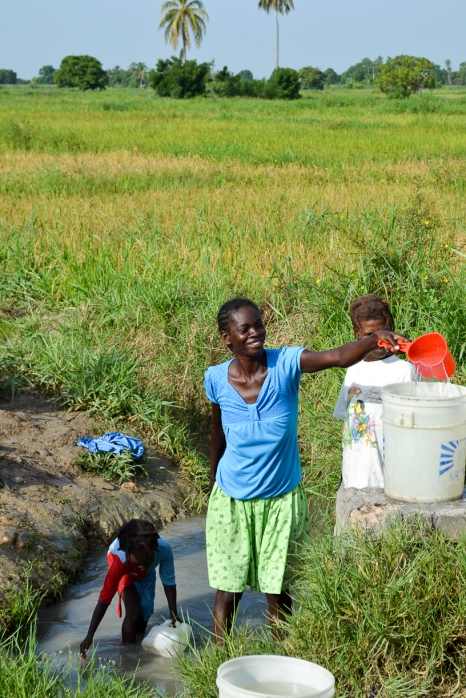
A canal in the Artibonite Valley.

This week we are seeing the long term impact of all the work that we do as an organization. This morning I spoke with Richard, our delivery co-ordinator that works with all of our Community Promoters to make sure that we’re meeting the demand for filters. The Promoters that he’s been in contact with over the weekend have reported that while some have lost gardens, there are a lot of people who now want filters because they know the threat of Cholera is very real and they’ve seen how those that have filters are not getting sick. Because there are few sanitation facilities, flooding leads to the spread of feces, the greatest contributor to the spread of Cholera and water borne disease. Those that have filters are not afraid for their health right now, because they know that they have a very effective way of protecting themselves.

As an organization we will always put a priority on being transparent and ethical in our fundraising efforts. We will always be honest with you about the reality, not exaggerating things just to raise funds. So, I am here being very honest with you right now in Irma’s wake – Haiti is not in crisis. We don’t need relief money right now. Not on the level that other countries do right now. Yes, there may be some communities that have had some impact, but it is not wide spread, and it is not a crisis. There might be some people or organizations that won’t like that I just said that, but I’m okay with that because it’s the honest truth.

We WILL tell you that we are hurting right now for finances because of a slump in donations, and that we would really appreciate your support as we continue to help families take control over their health. Your gifts WILL be effectively used. We’re seeing that this week as those families that would normally be heavily impacted by not having a source for clean water are drinking safe, clean water this week. It’s taken years to get here, but we’re rejoicing right now because we’re seeing all that hard work pay off.

Water sources like this are what most people have available to them in the Artibonite Valley.

We want to reach those families that are needing and wanting filters now, that don’t have another way to treat their water. But, we need your help. We would love it if you would donate so that the next time Haiti goes through a natural disaster, because we know that day will come again, those families will be equipped to care for themselves. Together we can help eliminate Cholera in Haiti. We’re on the way.

GIVE NOW

$100 will help provide a filter for a home. That filter will typically provide clean water, every single day, for 5-10 people. We visit each filter we install 3 times in the first year, and have just started 5 year visits. We know that over 95% of our filters will still be in use after the first year. That means that this time next year over 95 homes will still be using their filter in every 100 that we serve. In people that means over 475-950 people will daily have clean water available to them in their homes. They don’t have to buy it. They don’t have to worry that the water treatment boutique they might buy from, if they have money, isn’t working at 100%. They don’t have to worry that they only have canal water that looks like a mud puddle will be their only source. They will have control over the water they drink indefinitely for $100. $10-20 per person for long term life change. Seems like a great investment to me.

~Leslie

Hurricane Matthew – Does It Make A Difference?

Oct 15, 2016

It’s been over a week since Hurricane Matthew blasted through Haiti. There are so many feelings and thoughts swirling around in my head and heart, and it’s been hard to sort it all out. I don’t think I have yet, and I don’t know when I will. Little nuggets keep popping to the surface, and I’m thankful that they’re small because that’s what I can digest right now. Like so many here, I’ve been seeing posts from friends and other organizations on the ground that are helping with relief work down south. It’s devastating. Heartbreaking. I wish we could be there and on the ground, but I know that’s not our role in this.

It all feels overwhelming at times.

Yesterday I was thinking about the clash of emotions and thoughts. The conversations in my head where I would remind myself that we do something really well, and we’ve had experience with this kind of thing and know how we can best be supporting relief efforts right now. And yet, I would daydream about what other things we could be doing. Then I would remind myself that I needed to get filter forms prepared for another delivery day and get stuff ready for the guys to take out. That tomorrow we would be building filters again and preparing stuff for the next batch of installations that are most likely happening on Monday. That there’s a Community Promoter taking orders and collecting the co-pay that we require from each household so they invest in their filter and care for it well. All of these pieces working together like a well oiled machine, because it is. We know how to do this well from many years of trial and error, from making mistakes, from working with the local community and our Haitian staff, and we keep tweaking. Always trying to do it better.

I think about the press notes released from the WHO (World Health Organization) this week. The documented cases of Cholera throughout the country are starting to climb. The numbers grow most rapidly in the south, but the Artibonite is in there too. It’s several departments away from the southern regions, but showing the third highest increases in the country. This is our area. This is where we’ve been working for years.

I feel overwhelmed again because Cholera brings with it a sense of immediacy. For those with weakened immune systems, it can kill in 24 hours. The Artibonite is the area that has been most affected by this stealer of life since 2010 when cases were first reported. I want to shift into high gear. To get out there faster. To push harder.

But then I remember that this is not who we are. It’s not what we do.

No. Harder and faster is not the way we work. We work steady. We work calculated. We work in a way that means we can provide the follow up and care in line with our initial output of filters. Our whole goal is to be a constant presence for the long term. We’re not running a sprint, we’re running the marathon. We know how to do this well, and the answer right now, no matter how much we might feel we could be doing, is to stick with what we know works. What others have affirmed works.

20140903-20140903-085-46

I find my thoughts shifting from what I wish we could do, to what we have done.

And then I feel the conversation turn a bit.

We have been working in the Artibonite for years. We have been working in the Artibonite for years.

We have installed thousands of filters there. We have installed THOUSANDS of filters there.

I think of the number of new Cholera cases again. And I remember when the outbreak started back in 2010. The cases climbed by the hundreds every week. It was out of control. It came so fast, and so hard, that people were blindsided. Running to try and catch up. Running to try and save lives. To educated people on how to protect themselves. To provide access to medicine, water treatment, help…

And I think about the numbers slowly going up. No case is a good case, but what if those thousands of bio-sand filters weren’t there this week? Would the numbers be going up by the hundreds again?

And I feel overwhelmed.

The full weight of what we’ve been working so hard for, of everything we do here at Clean Water for Haiti hits me like a wall.

It’s working.

20141001-dsc_0314-129

People have filters. Not everyone, but thousands upon thousands do. They’re getting clean water. They know how to protect themselves from this killer. We have communities waiting for filters because they’ve seen their friends and family and neighbours with one and they know it works. People who have filters aren’t getting Cholera. Plain fact.

We’ve done this thing, pushed at it and worked so hard for so many years because we know it works. But in that, we don’t get to see every life affected. We don’t because those people don’t get sick. We can’t count numbers of people that are protected because of the work we do, because it’s not possible. You can only count the ones that aren’t, the ones that don’t make it. We often talk about the fact that we will never truly know how many lives we’ve helped save because of what we do, simply because those people are still walking around today, healthy. Those kids might be going to school and sassing their parents. Moms might get to see their babies grow up, and grandparents live into old age. Dads might be out working in the fields to provide for their families. We will never know how many. 

20141001-DSC_0280-117

My heart feels so overwhelmed right now, but it’s not from feeling helpless this time, it’s from gratitude.

Gratitude that we get to be part of this. Gratitude that all the hard work, the worry, the sweat, and even the tears over the years has been worth it. So very worth it.

It settles in. This deep knowing.

There are thousands of people at work in the south right now helping in relief. This is their role. They are saving lives after this disaster.

And we are here. This is our role. Continuing to do what we’ve been doing all along – preventing a different kind of disaster.

So does it make a difference? This work we do? The support you give? All the dollars sent and used here in Haiti over the years?

I know it does. Thousands upon thousands in homes all through the Artibonite know it does.

Thank you for supporting the work we’re doing, whether you’re sharing about us with people in your circle or sending your hard earned finances. You are helping us save lives here. That isn’t an exaggeration, that is a fact.

~Leslie

Life and Death Responsibility

May 12, 2016

We’re going to veer away from some of the reader questions that we’ve been answering in the last few posts because there’s something that’s on my heart, and I think it’s important to talk about because it really does shape the way we do our work here in Haiti. What I want to talk with you about is the great responsibility that people like us have in the work that we do.

20140903-175-88

I think the idea of development is appealing to a lot of people. I think the majority of the human race all have an inborn desire to help their fellow man. It’s the reason that we respond with compassion when we know someone is in need. It’s the reason people get involved, initially, in development work. It’s why we have non-profit organizations for every need out there. And, it’s a good thing. But something can be good, and it can be not enough at the same time.

In the 10 years that I’ve been living and working in Haiti I’ve had plenty of opportunity to see humanitarian, missions, and development projects started. Some of them are really effective, but sadly a lot aren’t. That’s really a whole other series of posts, and isn’t what I want to focus on today. What I want to talk to you about is the fact that intentions are not enough, especially when we’re working in a capacity that directly affects people’s health.

There are a lot of household water filtration methods and tools out there. We, as an organization, have chosen to just work with one of those. We have a lot of reasons why we’ve chosen to work with the Bio-sand filters.

  • They’re something we can build in country with local materials.
  • We can use local labor in the construction, distribution and follow up – more impact for our donor dollars and helping in a broader way.
  • The technology itself is great for Haiti because it takes a lot of factors into consideration, including education levels, resource availability, culture, maintenance and overall cost in relation to effectiveness.
  • We can make them available to the entire population.

There are a lot more reasons, but those are the basics.

Like I said, there are a lot of other household water treatment options out there, and there are a lot of people implementing them all over the world, and that’s a great thing.

The problem arises when people don’t look beyond the actual implementation part. Implementation is a fancy word that we use in the industry that just means “put into use”. When we “implement” a filter we’re putting it into use in a home.

What we see happen in most cases here in Haiti is that an organization or group will decide that they want to help with the water issues here, so they look at options and decide to help get people some kind of filter. They decide what kind of filter to get, make arrangements to get a whole bunch of them, and then go and install them or distribute them. In theory this is a great and noble thing. Seriously. Where I struggle is not in the intention, but in how the whole thing gets done. How it gets implemented, if you will.

In most cases this work is being done by a group of visitors who are in country for a week or two. Often no one in the group has had any formal training on the technology itself. Yes, they may have had a crash course on how to install the filter, but most couldn’t actually tell you how it works. They couldn’t figure out what was wrong with it if it wasn’t working correctly, and they wouldn’t know how to fix it if they did know what was wrong. They come in, and maybe they’re working with local people in some capacity, but typically this is from a logistical perspective. The people here on the ground make all the arrangements for the group, and walk through the process with them.

Case in point, one January we were flying back to Haiti after our Christmas break. In the Miami airport we made ourselves comfortable in the boarding lounge, and not long after about 15 people wearing matching shirts came and sat right next to us. Their shirts were advertising that Haiti didn’t have clean water, so they were bringing it to the people. As is usual, because our family typically gets noticed, a couple of the team members started to make conversation. Eventually we got around to What do you do? We told them we run an organization that does Bio-sand filters. They got very excited and said, “That’s what we’re going to do! It’s really great. We’re going to install Bio-sand filters in people’s homes this week.” We smiled politely. Then they asked me how long we’d been doing this. “I’ve been there for 7 years” I answered. 7 months? they asked. “No, 7 years.” And then everyone felt uncomfortable and they started playing with their phones. I hadn’t been rude in the least. I’d been very kind. They felt uncomfortable because in that split second they realized that we did this every day, and they were going to do it for a week, and then leave.

Once the filters are distributed or installed, what happens then? Normally the group goes home.

Who does the family call if their filter isn’t working? Anyone? There probably isn’t anyone for them to call.

Does anyone visit the filter regularly to make sure that it’s still working correctly? In most cases the answer to this question, with any filter program is no.

20140903-041-26

Please hear me when I say this – I’m not digging at people’s intentions. It’s not about that. Good intentions start with something deeper – the desire to help people. That’s a good thing. No, it’s not about intentions. For me, for us, it’s about loving people fully and well.

Hear me out.

When we’re sick, we go to the doctor, we don’t go to the grocery store and talk to the produce guy. We don’t do that because the produce guy isn’t a doctor. He’s not trained to diagnose and help heal. Need to know how to pick out the best tomatoes? Yes. Diagnosing that nasty rash? No. It’s obvious, right? You trust someone that has training and experience to help with a specific need.

When you are sick, you recognize that the human body is fragile, in the sense that if you do the wrong thing, were diagnosed with the wrong malady or were prescribe the wrong medication it can do a lot of damage. Doctors are required to swear to and abide by the Hipocratic Oath – first do no harm. That’s why no produce guy.

When we’re working with water filtration we are firstly working with people’s health, and we should want to do the very best we can in a way that will do no harm.

That’s it. There is no way around it.

If we want to love people fully, we should do the very best we can for them, even if that means putting our own needs aside. If the very best is to give them access to a tool that can improve their health, we should do that in the very best way we can. We should not do it half way, or in a way that could potentially lead to harm. If we do something really well, sometimes that means we have to put our own needs and desires aside to make sure that happens. If the best thing is to do it ourselves, that’s great. But, if the best thing is to support an organization that is trained to do it better then we ever could, even if it means we’re a bit more removed from the process, then we should go that route. Again, if we really want to love people, it means doing what’s best for them.

When we’re asking a family to adopt a filter, to use it every day, we’re asking them to trust us with their health. It’s not just about the idea of clean water. It’s about getting them something that won’t kill them.

Yes, I just said that. I said it because it’s true. I said it because when a filter is installed poorly, incorrectly, or doesn’t have adequate education or follow up we can literally be killing people. When we ask them to put confidence in any kind of water filter, we have a huge responsibility to make sure that it’s going to do it’s job, and do it well.

We’re asking mothers to trust that a filter is going to provide clean water for their babies. We’re asking families to trust that the filter is going to provide clean water for their older family members, or those with depleted immune systems that can’t fight off disease.

20140903-088-48

If we install a filter and the family doesn’t know how to use it properly, or it’s not installed and working properly, and they think it is, we can be causing a lot of damage.

That is a responsibility that is ever before us, and it’s one we take very seriously.

It’s the reason why every filter we install gets a form with all the needed information about the household and filter. It’s the reason those forms get entered into a data base so we can be tracking our technicians work and how we’re all doing our jobs. It’s the reason each filter gets three visits in the first year. It’s the reason each of those installations and follow up visits are done by a very well trained technician who works with the filters every. single. day. It’s the reason that we repair and replace broken filters for free. It’s the reason we welcome and get excited about research teams coming to check on our work, and listen to their results and use them to do it even better.

It’s also the reason why, when we get contacted by a well meaning group of people to ask if we can supply filters for them to install, we say no*.

We believe in our responsibility to do no harm. Water borne disease is a real thing. Illnesses, like Cholera, that can whip through a healthy persons body and kill them in 48 hours are a real thing.

If we do our job right, and well, people can trust that their filter is working properly and helping them to get healthy. If we don’t, and people are putting confidence in a filter that’s not actually properly removing all those disease causing microbes, they will get sick. And, they might die.

It’s a life and death responsibility. When people contribute to the work of Clean Water for Haiti, they can have confidence that we’re working from a place of deep love for the Haitian people that drives us to do what we do really well.

First, do no harm.

~Leslie

*We do like to tell them about our Vision Trips that will give them the opportunity to spend a week with us and work alongside our staff to learn about the whole process of building filters, and to go out on a delivery day to see how we install them and work with families. So, we’re not big meanies, we just work in a really specific way.

This post originally appeared on our old Clean Water for Haiti blog.


Contact Us

We love to hear from you. Let us know what's on your mind.

Send Message

Contact

  • 1-360-567-8647
  • office@cleanwaterforhaiti.org
  • Clean Water for Haiti US
  • Box 871181, Vancouver, WA 98687
  • Clean Water for Haiti Canada
  • Box 51, Armstrong, BC V0E 1B0

Follow Us

Our Latest Blog Post

Full Speed Ahead!

December 12, 2024

Phew! Is anyone else feeling the rush of the holiday season?...

© 2026 · Clean Water for Haiti/CWH Foundation

  • Buy Highend